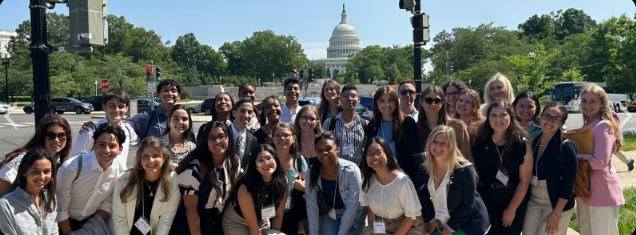
There’s a moment every journalism student knows well. You’re sitting in a media writing class, crafting a story about something that happened three weeks ago, wondering what it actually feels like to report on something that matters — right now, in real time, with real stakes. That gap between classroom work and real journalism can feel enormous. The National Press Club Journalism Institute (NPCJI) is one of the few programs that genuinely bridges it. And right now, their Summer 2026 internship is open for applications — but only until 11:59 p.m. ET on Sunday, April 12, 2026.
If you’re a college junior or senior in the Washington, DC area studying journalism, communications, or anything adjacent, this is worth your full attention.
What Is the NPCJI, and Why Should You Care?
The National Press Club has been a cornerstone of American journalism since 1908. Its nonprofit affiliate, the National Press Club Journalism Institute, carries that legacy forward with a specific focus — training, educating, and professionally developing journalists in an industry that’s changing faster than most people can keep up with.
The NPCJI isn’t just a historic name on a building. It’s an active organization running webinars, on-site workshops, one-on-one coaching sessions, and a daily newsletter called The Latest, which tracks developments in the journalism industry. When you intern here, you’re not filing papers in a back office. You’re working inside a living, functioning institution that shapes how journalism is practiced and protected in America.
That distinction matters. A lot.
What Will You Actually Be Doing?
Let’s get specific, because vague internship descriptions are one of the most frustrating things in any job search.
As a NPCJI summer intern, your work will span several areas:
Reporting on the journalism industry itself. This is genuinely interesting territory. You’ll be covering the business, ethics, and evolution of media — stories about how newsrooms are adapting, what threats press freedom faces, and how journalists are navigating a rapidly shifting landscape. It’s meta journalism, and it requires real analytical thinking.
Creating training resources. The Institute produces materials that journalists across the country actually use to sharpen their skills. As an intern, you’ll assist in developing those resources. That means your work has a downstream impact well beyond the internship itself.
Covering NPCJI events. The National Press Club hosts some of the most significant figures in media, politics, and public life. Reporting on those events — capturing what was said, why it matters, and what it means for the broader journalism conversation — is hands-on reporting experience that very few internships offer at this level.
Supporting press freedom initiatives. This is where the work gets meaningful in a larger sense. Press freedom isn’t an abstract concept — it’s an ongoing fight, and NPCJI is actively involved in it. Interns contribute to that effort directly.
You’ll also get mentorship from experienced reporters and media professionals. Not a one-time coffee chat. Actual, sustained access to people who have done this work at a high level.
Who Is the Ideal Candidate?
The eligibility requirements are clear, so let’s walk through them honestly.
You need to be a college junior or senior — or a graduating senior — pursuing a degree in journalism, communications, or a related field. “Related field” gives some room. If you’re studying political science with a journalism minor, or English with a strong portfolio of published work, it’s worth applying. The emphasis is on demonstrated interest and skill, not just degree title.
You must live in or near Washington, DC, and be able to arrange your own housing. This is a hard requirement. NPCJI is not offering relocation assistance or housing stipends, so if you’re based outside the metro area, this particular program isn’t your match — but it may be worth bookmarking for future reference if you’re planning to be in DC.
Strong written and verbal communication skills are non-negotiable. This is a journalism institution. Your application materials themselves are an audition. Every sentence in your cover letter is being evaluated.
Proficiency with Microsoft Office Suite is expected, as is familiarity with social media platforms and tools like Canva. AP style knowledge is listed as preferred — if you haven’t already internalized AP style from your coursework, spend some time with the AP Stylebook before you apply.
How Do You Actually Apply?
The application has three components. None of them should be rushed.
1. Your Resume Keep it clean and focused. Lead with education, then relevant experience, then skills. If you’ve written for your campus newspaper, contributed to a podcast, managed a social media account for a student organization, or produced any media content — it belongs here. Two pages maximum. One page is ideal if you can manage it.
2. Your Cover Letter This is where most applicants lose the opportunity before it even begins. A generic cover letter — “I am writing to express my interest in the internship position” — signals that you haven’t done your homework.
Your cover letter needs to do three things: show that you understand what NPCJI actually does, connect your specific experience or academic work to their mission, and communicate genuine enthusiasm for journalism as a public service. Reference press freedom. Mention The Latest newsletter if you’ve read it. Show that you know who they are, not just that you want an internship somewhere in DC.
One practical tip: read the NPCJI’s recent output before you write a single word of your cover letter. Visit their website, subscribe to their newsletter, look at recent events they’ve hosted. Thirty minutes of research will make your letter measurably stronger.
3. Up to Three Work Samples Choose carefully. Quality beats quantity every time. A sharp 600-word news article that demonstrates real reporting — source interviews, verified facts, a clear news angle — is worth more than three mediocre pieces. Class projects are explicitly welcome, which means your academic work is fair game if it’s strong.
If you have an interview you conducted, a report you researched, or a multimedia piece you produced — these all work. The goal is to show the range of your skills while leading with your best work. Put your strongest sample first.
CLICK HERE TO APPLY
Questions can be directed to the Institute staff at institute@press.org.
What Does This Do for Your Career?
Here’s the honest answer: an internship at NPCJI won’t guarantee you a job in journalism. Nothing does, in this industry. But it does several things that matter.
It gives you bylined, real-world work in a credible institutional context. Future employers — editors, communications directors, newsroom managers — recognize the National Press Club name. That recognition opens conversations.
It plugs you into Washington’s journalism community at a time when networking in this field is as important as ever. The contacts you build during a summer at NPCJI — mentors, peers, professionals you meet at events — can shape your career trajectory for years.
It also gives you something harder to quantify but equally valuable: clarity. You learn what this work actually feels like at a professional level. Whether that confirms your passion or redirects you toward a related path in communications or media strategy, that self-knowledge is worth the application effort alone.
What If You’re on the Fence?
Some students hold back from applying to competitive programs because they don’t feel ready. They tell themselves they’ll apply “next time” when they have more experience. It’s a reasonable feeling and a bad strategy.
The students who get selected for programs like this aren’t always the most experienced. They’re often the most intentional — the ones who researched carefully, wrote authentically, and submitted with conviction. Your campus newspaper clips and class projects are enough to make a case, if you frame them well.
The application deadline is April 12th. That gives you time to do this properly — not rushed, not last-minute, but thoughtfully prepared. Start today. Draft your cover letter, pull your best writing samples, and ask a professor or mentor to review your materials before you submit.
Washington has a summer internship waiting for someone who cares deeply about journalism and the public good it serves. Make the case that it should be you.